Death Stranding 2, My Mom, and the Ghosts We Carry
My Mom died on June 24, 2025. Death Stranding 2 released on June 26. I started playing it almost immediately. This is about what happened next.
My Mom died on June 24, 2025. Death Stranding 2 released on June 26. I started playing it almost immediately. I’m still not sure I can fully explain why grieving my mother took the shape of a video game about a courier walking across a broken world, but it did. The more I played, the more it felt like the only way through.
The first video game I remember playing was Super Mario Bros. I was nine. My Mom came home one day with a Nintendo Entertainment System, not because she was into games or had done any research, just because she thought I might like it. She set it up and watched me play. I still remember how happy she was that I was happy. The joy it brought her kids was the only thing she cared about. She didn’t question why I was playing video games in the middle of the day. Not when I was nine, and not when I was in my forties.
So when I picked up Death Stranding 2 days after her death, there was already a thread running back to her. She’d put the controller in my hand in the first place.
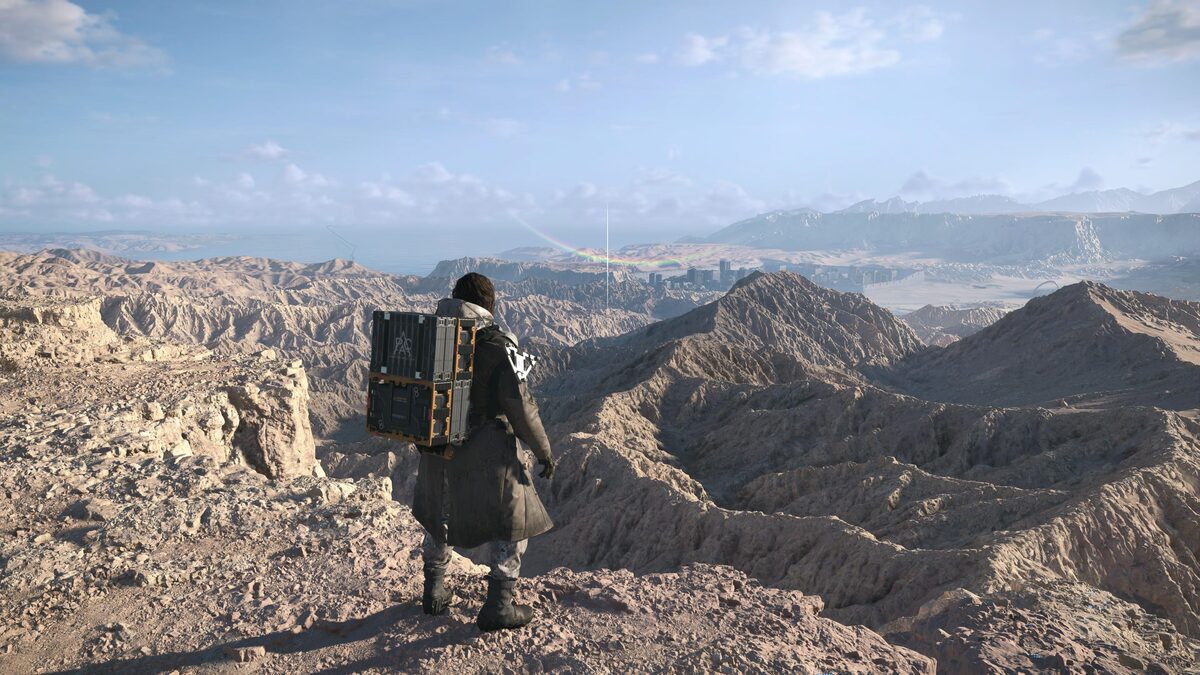
Death Stranding 2 is, mechanically, a game about walking. You play Sam Porter Bridges, hauling cargo across vast, mostly empty landscapes, and most of what you do is put one foot in front of the other. The walking is ethereal. You’ll cross a stretch of grassland under a wide pale sky, and the only sound is your own footsteps and a distant ambient score, and you’ll feel calm in a way games rarely make you feel. Then the sky darkens, the rain starts, something foreboding gathers at the edges, and you understand you’re not safe, and you weren’t ever really safe, you just got to forget for a while. Grief works the same way: the long, quiet stretches where you almost feel okay, and then the weather shifts. You can’t go around it; the only way to the other side is through it.
I did a lot of thinking on those walks. I’d think about the last time I saw her, how fast it ended, things I should have said, things I did say, and things that didn’t need saying because she already knew. I would set off from a delivery point with a stack of cargo on my back and arrive an hour later with no memory of the route, lost in a daze of sadness.
Hideo Kojima’s father died when he was thirteen. That loss shaped the entirety of Metal Gear, games Kojima has described as being about killing your father. But while he was developing the first Death Stranding, his mother died too. He’d been keeping the project secret from her. In a Vulture interview from 2019, he explained why:
I thought, I’ll tell her once I’ve become a little successful. I didn’t want her to worry. But she died during the game’s gestation.
And then, on what the game became because of it:
The ghosts in the game — maybe my parents are one of them, seeing me in this world. I wanted to have that kind of metaphor, that within you, you’re connected to the people that passed away.
I read this after I’d already been playing for a couple of weeks. It reframed everything. The game I’d been using to grieve my mother was a game its creator had built while grieving his. He made it about connection, about strands tying the living to the dead, because that was the metaphor he needed. It turned out to be the metaphor I needed too.
There’s a moment in Death Stranding 2 where Sam loses Lou. I won’t spoil the details. The game does not look away from his grief. It sits with it, drags it out, lets Sam carry it the way he carries everything else, slowly across long distances, with no real option but to keep going. Watching him made me feel less alone, which is exactly what Kojima has always said he wanted his games to do. At one point, Deadman tells Sam, “Death can’t tear us apart.” At the end of the game, Fragile says, “You will never be alone, we will always be with you.” I don’t believe either of those lines literally. I’m not sure Kojima does either. But I believe them the way you believe a song lyric: something true about how it feels, even if it isn’t true about the world.
After all those walks, I arrived at something she already knew. She would have told me she’ll be ok, and I will too. And when she saw me playing a video game in the middle of the day in my forties, grieving her in the only way I knew how, she would have just been happy that I was happy. Or close enough to happy, or finding my way back to it.
She gave me video games. Of course, this is how I found her again.
Have thoughts? [email protected]
All posts →